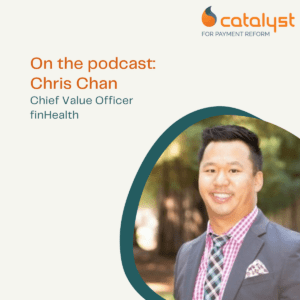
Chris Chan on Empowering Employers with Claims Data
In this episode of Listening In (With Permission), Ryan calls Chris Chan, Chief Value Officer of finHealth, to discuss the pitfalls many self-insured employers face related to their claims review

In this episode of Listening In (With Permission), Ryan calls Chris Chan, Chief Value Officer of finHealth, to discuss the pitfalls many self-insured employers face related to their claims review
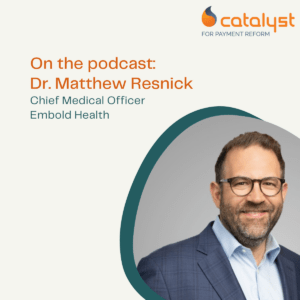
In this episode of Listening In (With Permission) Dr. Matthew Resnick, Chief Medical Officer at Embold Health, discusses with Ryan the evolution of quality measurement and improvement in healthcare, emphasizing

In this podcast episode Dayne and Tim Huke, Chief Growth Officer for Cedar Gate Technologies, explore firsthand the core of CPR’s latest case study, Unlocking Value: Diabetes Care Management Vendors’
In our latest episode of Listening In (With Permission), Guy calls Rob Andrews, founding CEO of the Health Transformation Alliance (HTA) and former U.S. Congressperson. Listen in as Rob and
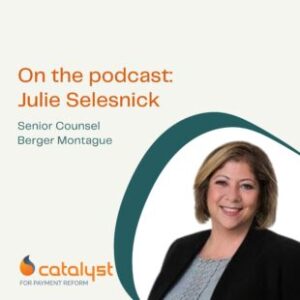
Part three of our three-part Data Podcast Series. In this episode of Listening In (With Permission), CPR’s Director of Member Services, Ryan Olmstead engages in a captivating conversation with Julie
Part two of our three-part Data Podcast Series. In this insightful podcast episode, we dive deep into the evolving role of Chief Financial Officers (CFOs) in healthcare purchasing. Join Ryan
Part One of our three-part Data Podcast Series. “So when I say it’s a gift, anytime a consumer gets enough information to make an informed decision, it’s a gift.” Listen

$935 billion. It’s hard to imagine what that number really means. It’s approximately the amount the United States spends on Medicare, it exceeds our national military spending, and it’s more than what

Food insecurity is more prevalent in the United States than you might think, and it has wide-ranging implications on health outcomes, GDP, and employee success. In 2020, 13.8 million households were food

Before the pandemic, the use of telemedicine was steadily increasing as a care modality, but still faced regulatory, payment, and logistical challenges that hindered its widespread adoption. But when the world shut

Job postings and new C-Suite openings for chief health equity officers (CHEOs) have become more and more common over the last few years. The American Medical Association announced the hiring

In 2020, CPR started its work with the NY Health Foundation (NYHealth) to track the state’s progress toward creating an environment that empowers consumers, while shining a light on areas

32BJ Health Fund | New York’s pricey hospitals draw pushback from labor Aon | U.S. Employers Eye Provider Networks Amid Looming Medical Cost Pressures, Aon Reports CalPERS | CA VBID Program Boosted Primary

Like any 501c3 nonprofit (and many organizations for that matter), CPR must remain nimble. We recently setup the capability to accept tax-deductible contributions to fund our important work. You can also get involved with CPR. For example, you can become a member, participate in our enterprise subscription program, collaborate with us on research or thought leadership. Know that regardless of how you contribute, your support is going to a small, but mighty organization tackling health care’s biggest challenges on behalf of employer-purchasers.

At CPR, we have a saying: if you don’t have a REF, you can’t trust the scoreboard. That’s why CPR created “Reform Evaluation Frameworks,” or – affectionately – REFs.
REFs are program evaluation tools that compel plan administrators and point solution vendors to use a standardized methodology and standardized set of performance indicators to measure cost savings, clinical quality and utilization.
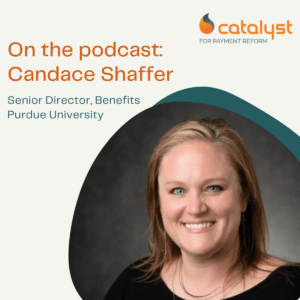
Suzanne calls up Candace Shaffer, Senior Director, Benefits at Purdue University to discuss the benefits purchasing strategies that she and her team have implemented and some of the tremendous savings as a result of those strategies.
Andréa calls Dr. Vikas Saini, President of the LOWN Institute to discuss their Hospital Index which measures a hospital’s social responsibility, examining how hospitals rank in terms of health outcomes, value and equity. The index is comprised of 53 different metrics, Dr. Saini explains how they collect and analyze their data.

Andréa calls Dr. Vikas Saini, President of the LOWN Institute to discuss their Hospital Index which measures a hospital’s social responsibility, examining how hospitals rank in terms of health outcomes, value and equity. The index is comprised of 53 different metrics, Dr. Saini explains how they collect and analyze their data.

Granted, most HPUG meetings veer more toward “engaged conversation” than “heated debate” but this is how CPR moves the Overton Window. CPR members don’t just ask health plans for updates on how many dollars they’ve dedicated to their bundled payment program: we push them to respond to tough questions in new territory like data sharing, health equity and their post-COVID payment reform strategies. We make them all take the same test through our program evaluation tools so they can’t cherry-pick statistics or hide behind shiny marketing materials. And because CPR members set the agenda for the HPUG meetings, the discussions focus on what matters most to you, purchasers, and what keeps you up at night. It’s OK if the health plans squirm a little; it’s what helps them grow.

Julianne calls up Doug Aldeen, ESQ an ERISA Healthcare Attorney and General Counsel to discuss the Reference Based Pricing (RBP) landscape, specifically how RBP has evolved over time.
Doug recounts his experience defending RBP companies from lawsuits and saw the evolution from uniform level reimbursement to variation depending on the market.
“Ultimately, the reason these facilities were coming after the RBP companies is it’s a market threat…you’re now a price maker, instead of a price taker.”